The Journey in Pages

In early 2025, I shared a quick rundown of the books I read in 2024, along with a summary of what I’d read in 2023. It was fun to write, and it gave me a small sense of accomplishment. I was hoping that anyone who read it would find some inspiration to dive into some great reads themselves. A few months later, during a Men’s Bible study, one of our group members shared his own reading adventures, which were humbling to say the last. He mentioned that he felt some of it was a waste of time, like he was just trying to brag about reading so many books. It seemed to him like it was a way to measure his intelligence or worth.

In 2025, I read a couple of books, or maybe sixty-seven, depending on how you count them. That’s because 2025 was a year I really focused on Bible study, almost to the exclusion of all of my other non-professional reading.  I managed to squeeze in a science fiction novella, Livesuit (you can skip it, it wasn’t brilliant) and I also read a chapter of The Weight of Glory by CS Lewis and some poetry by Rudyard Kipling. But mostly, I read the Bible.  All of it. I’ve done this before, several times. I think this was my second time in the Bible in a Year program, a podcast by a Catholic ministry associated with Ascension Press. Plus, I read a third of the Bible again through SOAP (I’m two years into the three-year SOAP program), which is sponsored by my church.

(I also read The Divine Conspiracy by Dallas Willard in 2025)

Why would I dedicate so much time to reading the Bible more than once?  Perhaps the best answer is another question: Have you ever read the same book more than once? Maybe it’s a classic or your favorite novel. Or have you listened to the same song, watched the same movie, or reruns of your favorite show? If so, why? Do you discover something new each time you read, listen, or watch? Is it just comforting and enjoyable? I could easily say the same about my Bible study and reading time.

By way of example this is the first year my wife and I engaged in the practice of making a list of familiar Christmas movies and shows and intentionally watching at least one each week as we approach Christmas.  They’re familiar, comforting, and enjoyable, and I always find something new in one of them that I didn’t notice before.  That list includes A Charlie Brown Christmas, Home Alone, Lost in New York, The Lion, the Witch and the Wardrobe, The Grinch Who Stole Christmas, Rudolph the Red-Nosed Reindeer, A Christmas Carol, and It’s a Wonderful Life, among others.  

I’ve got a selection of books to dive into this year, of course.  I’m planning to revisit “Resilient” and the accompanying audio program by John Eldgredge and the Wild at Heart ministry. I have a few Patrick O’Brian novels left to get to (I’ve done five of the twenty he completed).  I’m also looking forward  to The Language of Science and Faith by Francis Collins and Karl Giberson. If those names don’t ring a bell, Dr. Collins (MD, Phd) was the leader of the Human Genome Project and a director of the National Institutes of Health.  Dr. Giberson has a Phd in physics as well as BS degrees in philosophy and math (there’s a combination of studies!). I’m not expecting that one to be light reading, but I’m confident it’ll be a worthwhile investment of time.  I’m also planning to finish reading The Weight of Glory.  If you’re not familiar with CS Lewis from The Chonicles of Narnia, you could start there.  (My favorite Lewis book so far is Mere Christianity, which I would recommend to anyone.)    

I also follow two podcasts regularly; Security Now with Steve Gibson and Wild at Heart with John Eldredge, and a few others that I listen to on a less regular basis.  This probably takes up another 4-6 hours of my week when I can find the time. Work and home life tend naturally to be the priority, but I still strive to feed my head. 

Am I bragging? Hardly. I’m not exactly an “educated” person as conventionally defined. I graduated high school with a GPA that would best be described as “marginal.” I’ve occasionally attended college, but I’ve ended up with more incomplete classes than completed ones because of life’s demands and a tendency to procrastinate. But I still have a strong desire to learn and I hope this essay encourages you to engage with what feeds your faith and intellect.

I pray you are blessed and that you find your own rhythm of reading, writing, learning, praying, and loving.  

Road Trip

As I’ve gotten older, I’ve really come to love road trips. I’ve spent a lot of time driving from place to place, and what used to be a chore has turned into something I really enjoy. Most of my travel involves flying because of time constraints. I enjoy flying, but I’m not a big fan of airports, crowds, and lines. Time and the changes in air travel that have happened over the years have given me a different perspective.

Driving gives you a chance to see everything you pass. If you have the time, you can stop and look at all the beautiful spots, eat at the little diners, and get to know more of this amazing world we live in. As a business traveler, I’ve been to most of the big cities (and many of the small towns) in the US and even a few in Europe. I cherish all of those experiences. Driving through the Alps in Switzerland and Italy is like nothing else. Driving through the Rocky Mountains is its own dramatic experience. Riding through the Appalachian mountains and the causeway across Lake Pontchartrain in Louisiana are also special memories. The PCH (US Highway 1) in California is also very special to me. But these are places you can really only experience by car (or motorcycle).

Riding a motorcycle, or even driving with the windows down, lets you smell the places you go. Green trees have their own smell, especially pine and cedar trees. So does rain on the hills in Ireland. Or freshly tilled fields on our own plains in the US. It’s calming. It’s nature. It’s connectedness. I’ve never experienced this traveling at 500 miles per hour in an airplane at thirty thousand feet. That said, I have had a few opportunities to add a boat passage to a road trip and it’s so worth it! Crossing Lake Michigan from Manitowoc, Wisconsin to Ludington, Michigan was a wonderful addition to our motorcycle Circle Ride. Likewise, my World War II history tour in Europe included a cross-channel ferry trip from Portsmouth to Cherbourg. The sea has its own smell.  

I can’t stress enough how amazing it is to eat well. Once, I had a layover in Los Angeles that turned into a two-day adventure because of some airline mishaps. If I was stuck, I was going to make the most of it! I rented a car and drove up the Pacific Coast Highway from LA to Malibu. I explored the coast road and the canyon roads, and when I got hungry, I stumbled upon Bob Morris’s Paradise Cove Beach Cafe. I indulged in fresh seafood and sourdough bread, and then I walked along the beach. It was pure California magic, and I was almost glad I had been stranded by the airlines.

My friends Andy, Uly, and others in our group have turned our passion for small local dining into a hobby. We combine it with our love for motorcycle touring. Here in Michigan, we have a treasure trove of amazing places to explore (microbreweries, tap houses, diners, pizzerias, and so much more). And guess what? In neighboring Ohio and Indiana, these incredible places are never more than a few hours away.

Taking on Road Trips has been an incredible addition to my life’s adventures, and I highly recommend it for your next journey.  

Neushwanstien Castle, Bavaria, Photo by Author

The Stelvio Pass, Italy, Photo by Author

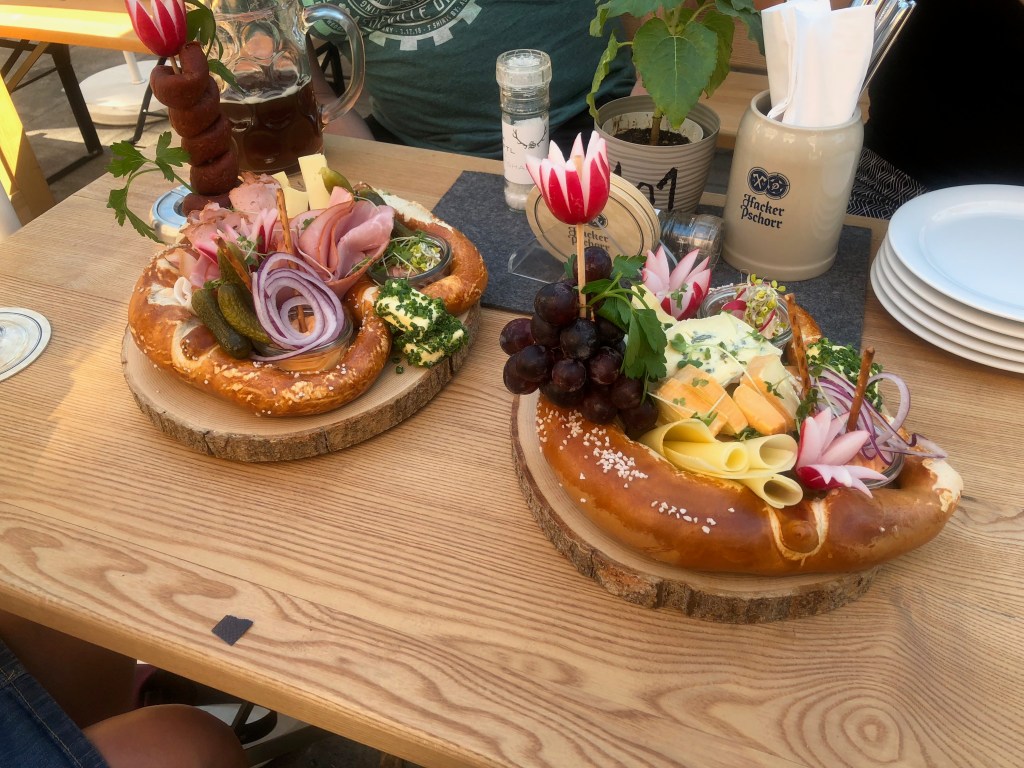
Snack Pretzels, Marienplatz, Munich – Photo by Author

On the road to Yellowstone, Wyoming – Photo by Author

Seek Discomfort

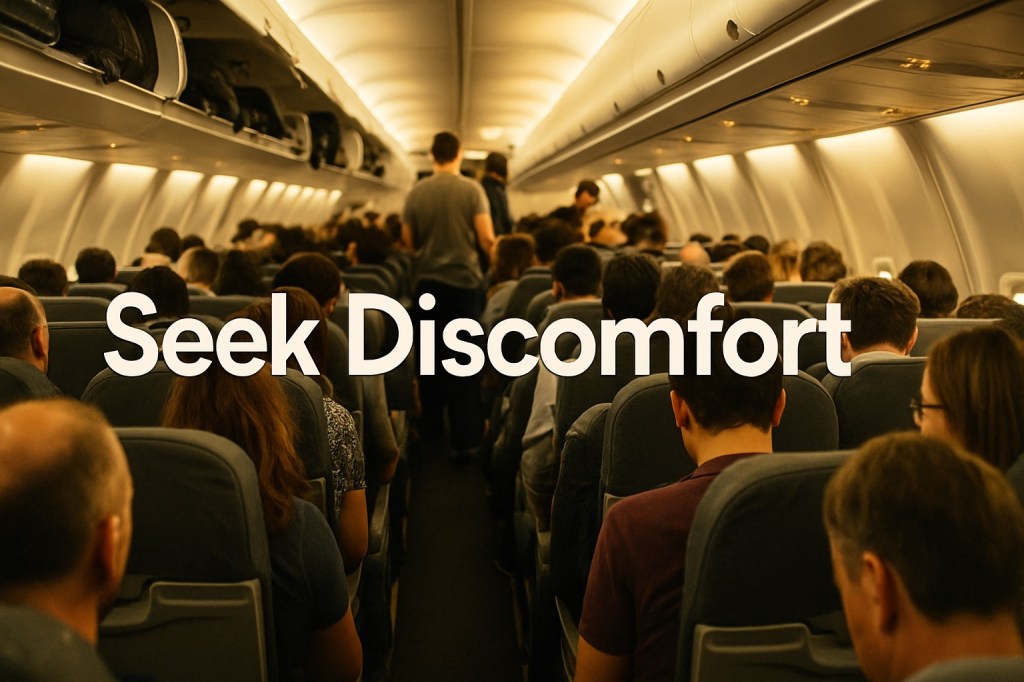
‘Seek Discomfort’ is what the print on the t-shirt said.  ‘You found it!’ is what I thought to myself.  The young lady was clearly adept at navigating air travel.  After decades of work and vacation-related flying, there’s something about commercial air travel that unsettles me.  I find it less than comfortable.  It doesn’t matter if I’m flying to Chicago or Tirana.  The bustle and crowds of the airports, the intrusiveness of TSA, the lines, and the cramped quarters on the plane contribute to my growing disaffection for the process.  It’s often the only practical way to do things, but I wish it weren’t.  (Don’t misunderstand me, I love aviation, but loathe airports – I’ll write bit on that, another day).    

After a bit of contemplation (and while I grabbed my own roll-aboard from the overhead and made my way down the too-narrow aisle) I realized that the slogan might have a deeper meaning.  So often we seek comfort first.  We make sure we live lives that are soft and as easy as possible.  ‘Convenience Culture’ is the term that is popular now.  Think Amazon, Door Dash and other forms of instant home delivery.  Covid amplified the emotional forces that often want us to stay on the couch.  And capitalism, as it so often does, caters to demand.  

We can contrast that to my friend Travis.  Travis seeks discomfort.  He’s part of the movement (there are a few other adherents in my circle of friends and acquaintances) that embraces ‘Cold Plunge’.  Yep, think of immersing yourself in water, as cold as 39F as a way to easy sore muscles, enhance focus, lower your core body temperature (voluntary hypothermia!), and decrease inflammation.  I’ve also recently (re)embraced discomfort in the form of gym exercise and workouts.  I have had seasons (not enough of them) where I’ve embraced exercise culture.  Sore muscles and other various forms of discomfort do lead to greater strength and fitness, which is what brings me to the idea of embracing the notion of ‘Seek Discomfort’.  

When we are too comfortable, we are not more resilient.  When life is too convenient we are not more creative or courageous.  We are just more dependent.  And not on those we love or care about.  Interdependence, the notion that we mutually build into the lives of our friends and loved ones, is vital.  Being unnecessarily dependent on comfort and convenience might kill you or at least make you miserable.  Perhaps this is part of the attraction of camping.  Where you spend a small fortune to live like a homeless person.  It’s less comfortable than our normal lives.  But it gets us closer to the natural world (yes, even the glampers with the 40’ fifth-wheel).  I enjoy camping.   

On some level, I’m going to seek more challenge.  I will absolutely enjoy a certain amount of comfort and convenience (I enjoy the heated seat in my car, for example), but I’m also going to embrace some practices that challenge my affection for convenience. Maybe then I won’t be so grumpy about having to sit in a center seat, at the back of airplane, late in the evening, when all I want is to be home with my love.  Not sure about that cold plunge though…

Curating

Over the last few years I’ve begun to curate my social media and content feeds so that I bypass the bulk of the negative, triggering posts and materials.  That’s not to say that I’ve created an echo chamber that caters only to my worldview, but I’ve intentionally started weeding out messaging designed to provoke a response.  So what’s the difference?

Most objective observers of culture would agree that media has (d)evolved.  There was once only a handful of same-story outlets for ‘facts’, ideas and beliefs.  The Internet has created a fabric of sites, feeds, and streams that anyone can contribute to.  This is good (sort of).  Having power over the outlets for information and ideas concentrated in the hands of a few was never a great thing.  There was zero innovation and zero diversity of thought.  But what we have now may not be better. 

Social media and news sites are a cacophony of blaring voices.  Media and journalism appear to have abandoned any sense of balance and objectivity.  It’s all about narrative, and the bias is not the least bit hidden.  Click-bait headlines are designed specifically to elicit an emotional response (and drive ad revenue).  Provocation, not information, is the new goal.  And I’m not sure we even have a diversity of thinking.  What we call ‘news’ is the same reflexive ‘follow-the scoop’ or ‘amplify the narrative’ sort of thing we got from the NBC nightly news or 60 Minutes.  

If the new way of things isn’t really different, why is the Internet realm different?  Because we now have millions of shrill voices from the extremes of culture, anyone with anything moderate or reasonable to say gets cancelled by one side or the other.  There are still no balanced viewpoints and even less civil conversation.  Everything is a moral imperative, and if you disagree (from either side), you are ‘the problem’.

So far, this all sounds pretty bad, right?  It doesn’t have to be.  I’ve muted the blaring voices (even amongst my friends).  On social media, it’s simply a click.  In person, it’s as simple as pointing out that there are two sides to every issue, and in most cases, they are both partly to blame for the problem and neither has a corner on the truth.  I haven’t watched TV news in 20 years.  I don’t have to participate in the news/hype cycle.  

Online, as in life, balanced perspective is key.  I had to learn to see things for what they are, not what everyone is all upset about and claiming they are.  If I got wound up about every issue that someone says is an existential threat to humanity or society, I’d be exhausted.  And a lot of people are exhausted.  I like to be informed.  But about real facts.  Not hyperbole and not emotional screaming.  Narratives are like bodily functions.  Everybody has them, and they’re typically not shared well.

As the world moves on (and it will), I hope we all learn that holding our virtual hands over our ears and screaming isn’t how we make the world a better place.  Following those who would constantly stimulate our adrenal glands won’t make your life (or anyone else’s) better.  Regurgitating talk radio (am I dating myself?) or podcast feeds about ‘what’s wrong with the world’ won’t endear you to anyone who isn’t wed to the same narratives.  We need to see the world through better eyes and listen with more compassion.  

Perspective

As I prepared to write this, I asked my new friend, ChatGPT, to give me the definition of ‘Perspective’. I got three answers (the 4o model seems more verbose than it’s predecessors) and this was one of them:

Mental Viewpoint:
Perspective is a particular attitude or way of thinking about something, often shaped by experience, culture, or context. For example, “From her perspective, the decision made sense.”

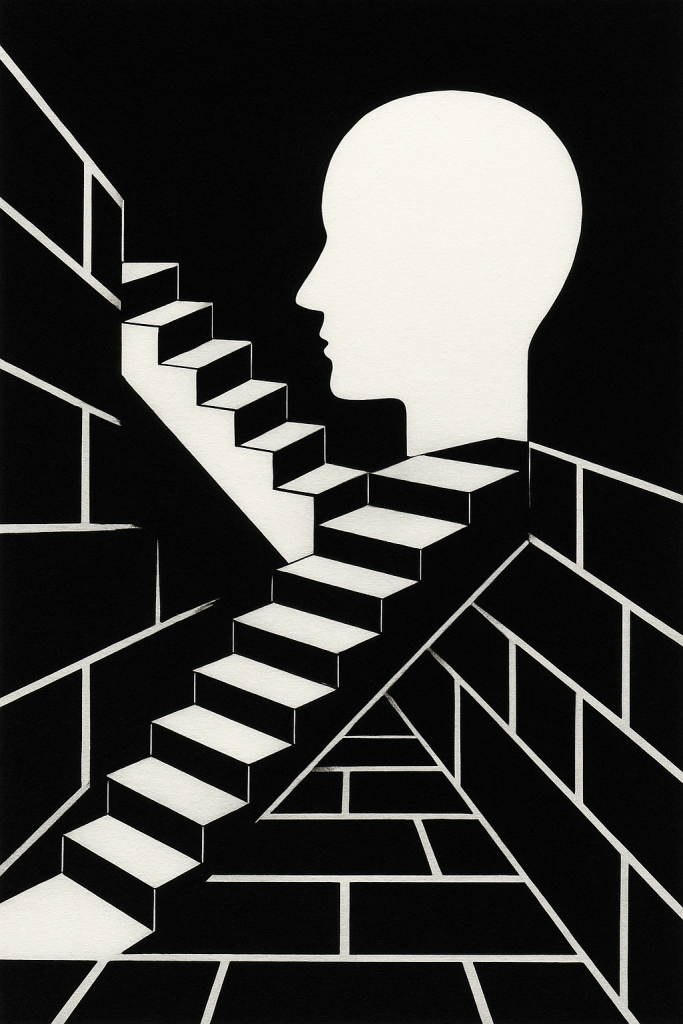
Then I asked for an image that represented the same. I’m not sure I completely understand the AI perspective on ‘Perspective’, but it is an interesting image.

Not unlike AI though, our minds and spirits (the part of us that lives in the earth suit of our bodies) is programmed, intentionally or otherwise. Part of the definition of ‘Perspective’ that says we are shaped by our culture and context. I would absolutely agree with that. Much of who I am as a person was shaped by my family and other life experiences. But what I didn’t figure out until much later in life was that you can intentionally shape your own perspective by curating your life. By this I mean by intentionally choosing things like:

  • Your daily practices and habits
  • Your friend group
  • Your work cadence and approach
  • Your social media and news feeds (or choosing not to have any)
  • How you treat other people
  • Your sense of gratitude

The great news is that all or at least most of this stuff is under your control. You just have to take that control. You may live in difficult circumstances, but that doesn’t have to mean that you are miserable. I have been acquainted with wealthy people, with every material comfort and blessing you could want, who are still deeply unhappy. I also have met children in the hills of Mexico, living in shacks without running water, who still play and laugh and enjoy their lives. Parking up in a yacht basin in the Caribbean won’t automatically make you happy, and waking up in an impoverished pueblo in Mexico won’t automatically make you weep.

For an even more stark example; the psychiatrist Victor Frankl was a prisoner in a concentration camp during WWII, living in the most appalling situation you can probably imagine. In the midst of this horror, Frankl concluded that that the primary human drive is not pleasure or power, but the pursuit of meaning. I visited the remains of the concentration camp at Dachau once. The still-palpable sense of darkness and heaviness is on that place, which the Germans have partially preserved as a stark reminder of that awful time in their history. Most of the barracks buildings are gone, and there is a beautiful memorial, but it’s still stark and foreboding. How could Frankl find that search for meaning when he faced this?

I would submit that he was able to do this through his perspective, or his control of it. To learn more, read ‘Man’s Search for Meaning’.

Another inspirational person from this time is Corrie Ten Boom. She was a Dutch watchmaker who helped Jewish people escape the holocaust before she and her family were swept up by the Nazis and sent to a concentration camp. She relied on her deep Christian faith to provide her perspective and sustain her through her ordeal. This is the approach I seek to rely on today to inform my perspective and guide me through my life. Read more about Corrie Ten Boom in her book ‘The Hiding Place’.

Memorial at Dachau – Photo by Author

No two of us has the exact same perspective, based on our life experience and context. We don’t get to choose where we come from. But we can control our perspective and outlook and how we choose to see and engage with the future. Having faith or a relationship with God, following positive practices, and choosing our responses can change everything. The good news is that the choice is in our hands and costs us nothing but focus and being intentional.

Gratitude

I read a post this morning, written by a longtime acquaintance and colleague, discussing gratitude as a perspective.  He had taken a day off but ended up working on a customer problem instead of what he had originally intended.  Despite this, he was grateful for his work, his life situation and his opportunity to do something good for someone else.  

Why did he take the time to post this on his profile on a professional network? (this was not Facebook or Instagram, but rather LinkedIn)  I believe it’s because it is part of his practice of gratitude.  He was intentionally focusing on the most positive aspects of his experience and regarding the benefits of it as they apply to his life and outlook.  

A popular definition of gratitude is: ‘a feeling of appreciation by a recipient of another’s kindness.  This kindness can be gifts, help, favors or another form of generosity…’

The common Wikipedia definition of gratitude (excerpted above) is a ‘feeling’.  But I would submit that gratitude can and should be an intentional practice.  We should find something to be grateful for every day.  Why?

Being grateful focuses our minds on the good things in our lives.  It may be gifts, it may be love, companionship, employment, money, food, our positive displacement in the world, our personal situation or anything really.  You can be grateful for a beautiful sunrise, or simply that you were alive to see it.  Or that you had a warm, yummy cup of coffee or tea to enjoy while you admired it.  A good friend of mine often makes reference to his gratitude to the ‘Kind and Generous Universe”. 

Having a posture of gratitude can alleviate anxiety.  It can guard against depression.  Being grateful makes us better people, partners, family and friends.  Being grateful protects us from our culture’s constant drive to purchase and consume more.  The antidote to the false narrative that ‘having it all’ is the definition of happiness.  

Best of all, being grateful is free.  You don’t have to pay anyone or anything for a sense of gratitude.  It’s something you cultivate in your own mind/spirit/soul.  And, as my colleague demonstrated today, it can be contagious.  

Hint:  That’s why I’m sharing this now.