As I prepared to write this, I asked my new friend, ChatGPT, to give me the definition of ‘Perspective’. I got three answers (the 4o model seems more verbose than it’s predecessors) and this was one of them:
Mental Viewpoint:
Perspective is a particular attitude or way of thinking about something, often shaped by experience, culture, or context. For example, “From her perspective, the decision made sense.”
Then I asked for an image that represented the same. I’m not sure I completely understand the AI perspective on ‘Perspective’, but it is an interesting image.
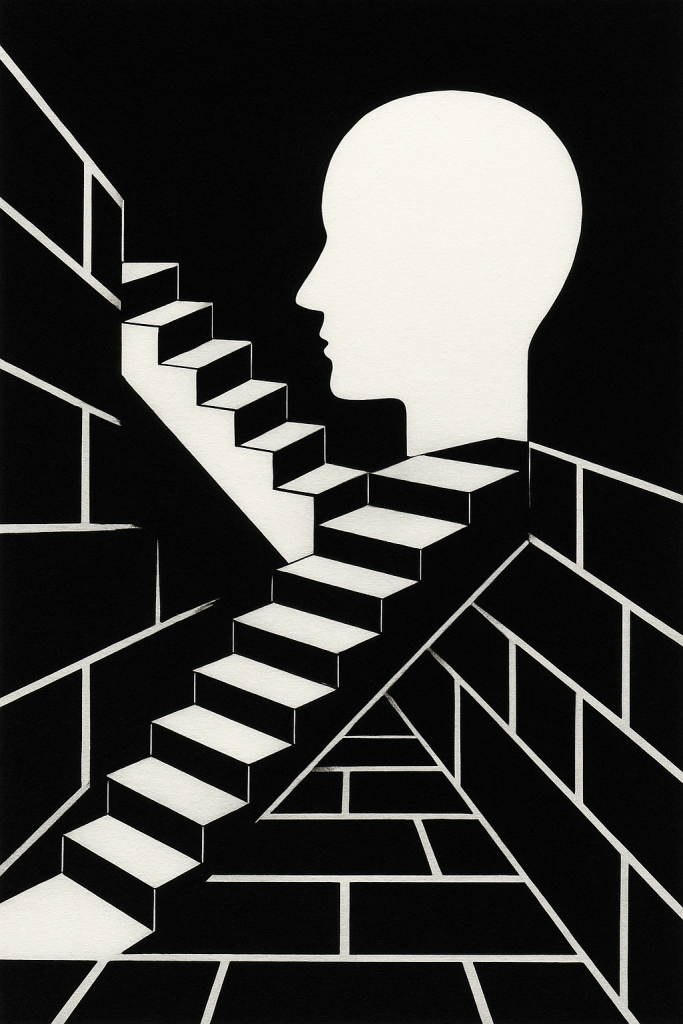
Not unlike AI though, our minds and spirits (the part of us that lives in the earth suit of our bodies) is programmed, intentionally or otherwise. Part of the definition of ‘Perspective’ that says we are shaped by our culture and context. I would absolutely agree with that. Much of who I am as a person was shaped by my family and other life experiences. But what I didn’t figure out until much later in life was that you can intentionally shape your own perspective by curating your life. By this I mean by intentionally choosing things like:
- Your daily practices and habits
- Your friend group
- Your work cadence and approach
- Your social media and news feeds (or choosing not to have any)
- How you treat other people
- Your sense of gratitude
The great news is that all or at least most of this stuff is under your control. You just have to take that control. You may live in difficult circumstances, but that doesn’t have to mean that you are miserable. I have been acquainted with wealthy people, with every material comfort and blessing you could want, who are still deeply unhappy. I also have met children in the hills of Mexico, living in shacks without running water, who still play and laugh and enjoy their lives. Parking up in a yacht basin in the Caribbean won’t automatically make you happy, and waking up in an impoverished pueblo in Mexico won’t automatically make you weep.
For an even more stark example; the psychiatrist Victor Frankl was a prisoner in a concentration camp during WWII, living in the most appalling situation you can probably imagine. In the midst of this horror, Frankl concluded that that the primary human drive is not pleasure or power, but the pursuit of meaning. I visited the remains of the concentration camp at Dachau once. The still-palpable sense of darkness and heaviness is on that place, which the Germans have partially preserved as a stark reminder of that awful time in their history. Most of the barracks buildings are gone, and there is a beautiful memorial, but it’s still stark and foreboding. How could Frankl find that search for meaning when he faced this?
I would submit that he was able to do this through his perspective, or his control of it. To learn more, read ‘Man’s Search for Meaning’.
Another inspirational person from this time is Corrie Ten Boom. She was a Dutch watchmaker who helped Jewish people escape the holocaust before she and her family were swept up by the Nazis and sent to a concentration camp. She relied on her deep Christian faith to provide her perspective and sustain her through her ordeal. This is the approach I seek to rely on today to inform my perspective and guide me through my life. Read more about Corrie Ten Boom in her book ‘The Hiding Place’.

No two of us has the exact same perspective, based on our life experience and context. We don’t get to choose where we come from. But we can control our perspective and outlook and how we choose to see and engage with the future. Having faith or a relationship with God, following positive practices, and choosing our responses can change everything. The good news is that the choice is in our hands and costs us nothing but focus and being intentional.
 Another Winding Road