Book Review – Good Anxiety: Harnessing the Power of the Most Misunderstood Emotion, by Dr. Wendy Suzuki

I’ve run into Dr. Suzuki’s videos on the Ted channel multiple times. My own journey through mental and emotional well-being drew me to her presentations on how the brain works. This book appealed because I have struggled with anxiety from time-to-time. Thankfully it’s not a permanent/chronic thing for me, but I know more than a few people that it is a nearly constant issue for. It led me to want to understand it more and Dr. Suzuki’s take on the subject was refreshing.

Listen to Dr. Suzuki talk about anxiety and her book: https://www.youtube.com/watch?v=FNKApPrhlew

I have to start this review off by saying I am a nerd. Academic things are interesting to me. But there are a LOT of practical applications here, not just material to feed my inner dork. It turns out there a lot of things I hadn’t thought of.

The first big idea was that anxiety isn’t just a debilitating or irritating malfunction of our brain. It serves a purpose. It is a natural response to stress and pressure. It can actually be helpful if we recognize it for what it is, harness the energy and focus it on positive things. For anyone that lives with terrible chronic anxiety this probably seems like little comfort, but for me it was a bit of a revelation. It’s the tension that helps some of us get motivated.

Dr. Suzuki shares that the flip-side of anxiety can be a superpower. If we learn to recognize and channel anxiety it can help:

Increase productivity

Boost performance

Sharpen Focus

Increase empathy

I think this last point is important. We risk becoming callous if we feel like we are immune to a particular mental or emotional condition. My own episodes of depression have made me so much more empathic for people with similar struggles. If you’ve endured seasons of anxiety, it helps you understand others and motivates you to support those in similar circumstances.

But on to the key point of rewiring our response to anxiety; Dr. Suzuki reminds us that our brains are pliable, even well into adulthood, although not so much as when we are young children. This is evident in people who have had mild strokes. It is very possible for them, with proper therapy, to learn and re-wire their brains to compensate for the stroke damage. I saw this in my own father. This flexibility, called Neuro Plasticity means we can rewire our responses to anxiety and use it to our advantage. We need to have an Activist Mindset, meaning we take an active role in our approach to dealing with anxiety and rely on our cognitive flexibility to effect change.

Of course change is often slow and comes in small increments, but by focusing on our response to stress and anxiety it’s possible make use of that energy, rather than letting it hurt us.

Overall, I’ve found this book very interesting and helpful in its perspective. Putting these concepts into practice, of course, takes effort and reinforcement, but it’s worth it. If you suffer from severe, debilitating anxiety, a book won’t be enough. Please seek profession counsel, advice and even medication if it’s indicated. We’re not meant to go through life immersed in stress and anxiety.
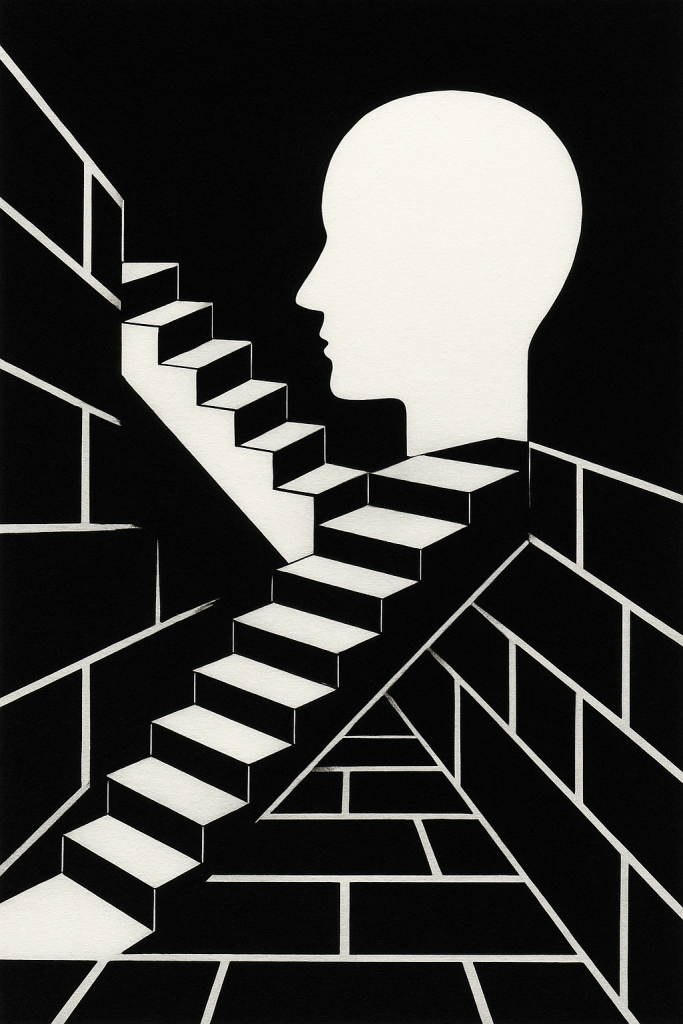
Perspective

As I prepared to write this, I asked my new friend, ChatGPT, to give me the definition of ‘Perspective’. I got three answers (the 4o model seems more verbose than it’s predecessors) and this was one of them:

Mental Viewpoint:
Perspective is a particular attitude or way of thinking about something, often shaped by experience, culture, or context. For example, “From her perspective, the decision made sense.”

Then I asked for an image that represented the same. I’m not sure I completely understand the AI perspective on ‘Perspective’, but it is an interesting image.

Not unlike AI though, our minds and spirits (the part of us that lives in the earth suit of our bodies) is programmed, intentionally or otherwise. Part of the definition of ‘Perspective’ that says we are shaped by our culture and context. I would absolutely agree with that. Much of who I am as a person was shaped by my family and other life experiences. But what I didn’t figure out until much later in life was that you can intentionally shape your own perspective by curating your life. By this I mean by intentionally choosing things like:

  • Your daily practices and habits
  • Your friend group
  • Your work cadence and approach
  • Your social media and news feeds (or choosing not to have any)
  • How you treat other people
  • Your sense of gratitude

The great news is that all or at least most of this stuff is under your control. You just have to take that control. You may live in difficult circumstances, but that doesn’t have to mean that you are miserable. I have been acquainted with wealthy people, with every material comfort and blessing you could want, who are still deeply unhappy. I also have met children in the hills of Mexico, living in shacks without running water, who still play and laugh and enjoy their lives. Parking up in a yacht basin in the Caribbean won’t automatically make you happy, and waking up in an impoverished pueblo in Mexico won’t automatically make you weep.

For an even more stark example; the psychiatrist Victor Frankl was a prisoner in a concentration camp during WWII, living in the most appalling situation you can probably imagine. In the midst of this horror, Frankl concluded that that the primary human drive is not pleasure or power, but the pursuit of meaning. I visited the remains of the concentration camp at Dachau once. The still-palpable sense of darkness and heaviness is on that place, which the Germans have partially preserved as a stark reminder of that awful time in their history. Most of the barracks buildings are gone, and there is a beautiful memorial, but it’s still stark and foreboding. How could Frankl find that search for meaning when he faced this?

I would submit that he was able to do this through his perspective, or his control of it. To learn more, read ‘Man’s Search for Meaning’.

Another inspirational person from this time is Corrie Ten Boom. She was a Dutch watchmaker who helped Jewish people escape the holocaust before she and her family were swept up by the Nazis and sent to a concentration camp. She relied on her deep Christian faith to provide her perspective and sustain her through her ordeal. This is the approach I seek to rely on today to inform my perspective and guide me through my life. Read more about Corrie Ten Boom in her book ‘The Hiding Place’.

Memorial at Dachau – Photo by Author

No two of us has the exact same perspective, based on our life experience and context. We don’t get to choose where we come from. But we can control our perspective and outlook and how we choose to see and engage with the future. Having faith or a relationship with God, following positive practices, and choosing our responses can change everything. The good news is that the choice is in our hands and costs us nothing but focus and being intentional.

Gratitude

I read a post this morning, written by a longtime acquaintance and colleague, discussing gratitude as a perspective.  He had taken a day off but ended up working on a customer problem instead of what he had originally intended.  Despite this, he was grateful for his work, his life situation and his opportunity to do something good for someone else.  

Why did he take the time to post this on his profile on a professional network? (this was not Facebook or Instagram, but rather LinkedIn)  I believe it’s because it is part of his practice of gratitude.  He was intentionally focusing on the most positive aspects of his experience and regarding the benefits of it as they apply to his life and outlook.  

A popular definition of gratitude is: ‘a feeling of appreciation by a recipient of another’s kindness.  This kindness can be gifts, help, favors or another form of generosity…’

The common Wikipedia definition of gratitude (excerpted above) is a ‘feeling’.  But I would submit that gratitude can and should be an intentional practice.  We should find something to be grateful for every day.  Why?

Being grateful focuses our minds on the good things in our lives.  It may be gifts, it may be love, companionship, employment, money, food, our positive displacement in the world, our personal situation or anything really.  You can be grateful for a beautiful sunrise, or simply that you were alive to see it.  Or that you had a warm, yummy cup of coffee or tea to enjoy while you admired it.  A good friend of mine often makes reference to his gratitude to the ‘Kind and Generous Universe”. 

Having a posture of gratitude can alleviate anxiety.  It can guard against depression.  Being grateful makes us better people, partners, family and friends.  Being grateful protects us from our culture’s constant drive to purchase and consume more.  The antidote to the false narrative that ‘having it all’ is the definition of happiness.  

Best of all, being grateful is free.  You don’t have to pay anyone or anything for a sense of gratitude.  It’s something you cultivate in your own mind/spirit/soul.  And, as my colleague demonstrated today, it can be contagious.  

Hint:  That’s why I’m sharing this now.